Realistic Full Body Human Figure Drawing
Being the fourth installment of my How to Depict Comics serial.
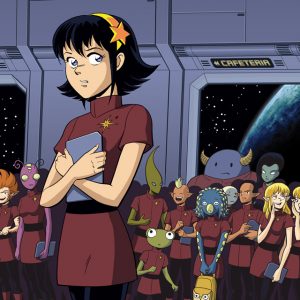 Now that yous know who your character is, it'south fourth dimension to draw her. Seeing how you're going to be drawing this character a lot over the class of your comic, information technology's a good blast down their look and then you tin can exist consistent. Nevertheless, information technology's not uncommon for a character design to evolve over time in a comic—it certainly did to the characters in Paradigm Shift—but spending the time to work out the graphic symbol's overall shape, costume and before starting Page 01 is worth the effort. Additionally, working on understanding human beefcake and effigy drawing do can actually take your graphic symbol drawing to a new level.
Getting Into Grapheme
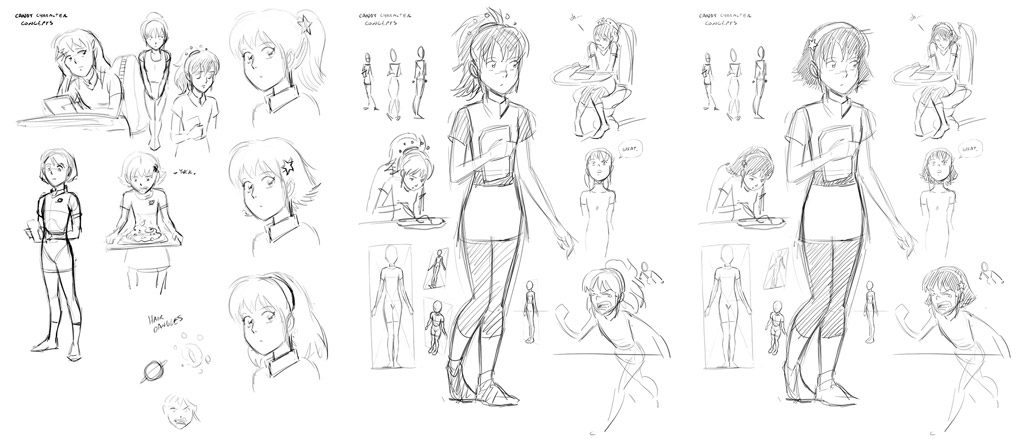
Here'southward some examples of playing around with a character before starting a project. This is Candy from STRANGER. I knew I wanted her to look a fleck like a Miyazaki character, but I played around with a couple of designs before settling on her final look:
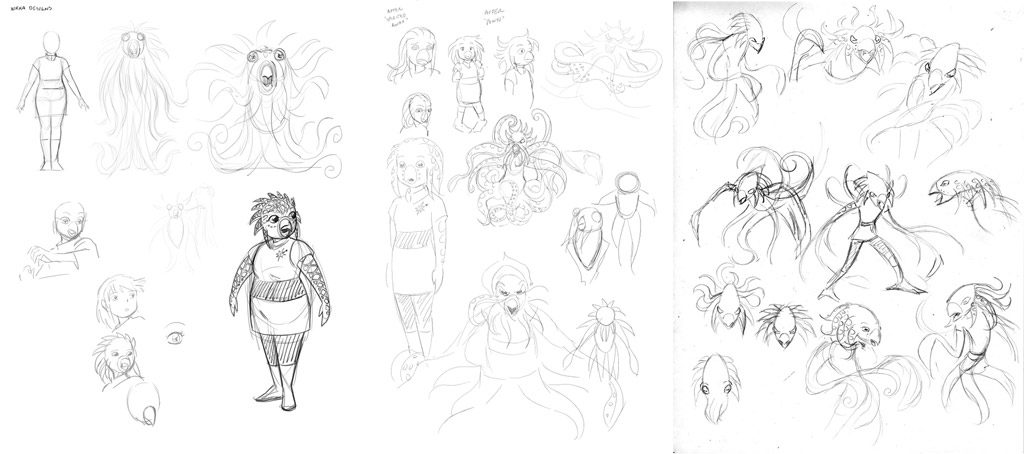
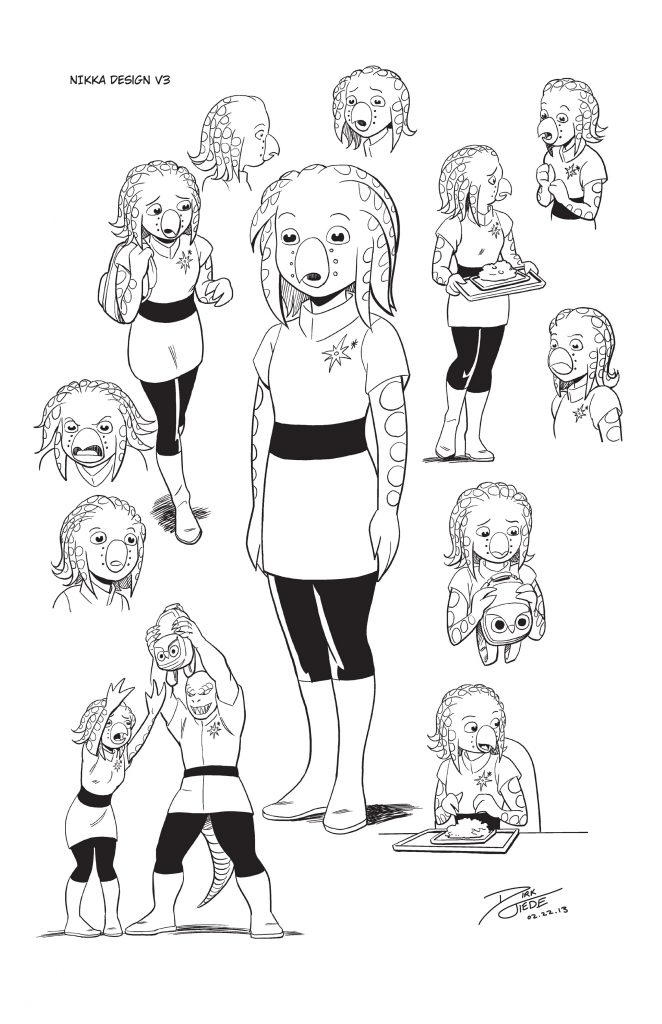
For Candy's analogue, Nikka, it took a little more work before I nailed down her design. Over again, I took some inspiration from Miyazaki past riffing off of Sen from "Spirited Away". However, by borrowing the rounder caput and broad-spaced eyes and combining them with features inspired past a cuttlefish, I was able to create something entirely new.
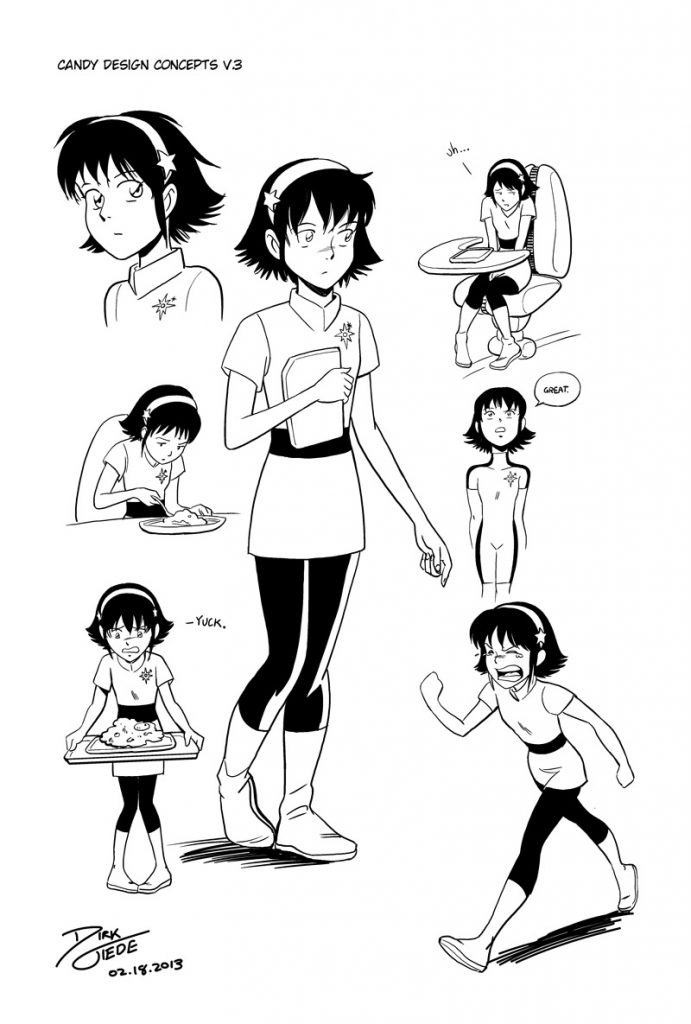
Here's her concluding blueprint:
A Quick Note on Silhouette
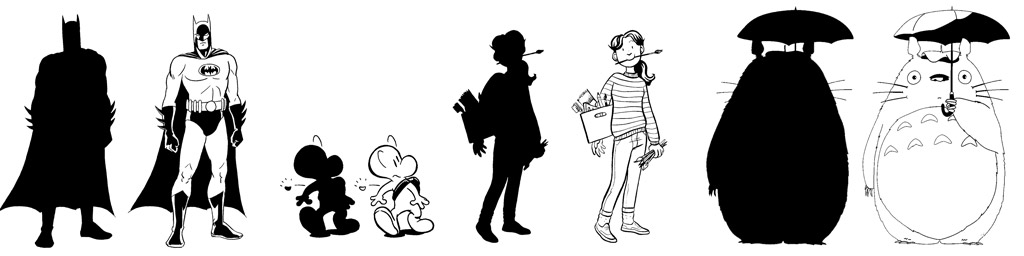
The first thing anyone volition encounter well-nigh your character is the shape his or her outline creates, not the details within. Having characters with distinct body and head shapes will help make them more recognizable in your story.
The Head & Face
Firstly, allow's wait at the caput and confront considering the are probably the most important features for identifying your character and letting him express himself. Even the shape of the caput tin advise a personality—triangular, round, square. Each gives a different experience. Too, adding differently shaped hair or other features that tin create a unique, recognizable shape can help tremendously equally well. This is how I designed the alien characters for the story STRANGER:

In order to draw my characters' heads from any angle, I use two bones head shapes equally a starting bespeak and then squash and stretch them into the estimate shape. I borrow from techniques used in blitheness to construct a grapheme from more bones shapes underlying the head. The first is the classic anime "seed" shaped head:
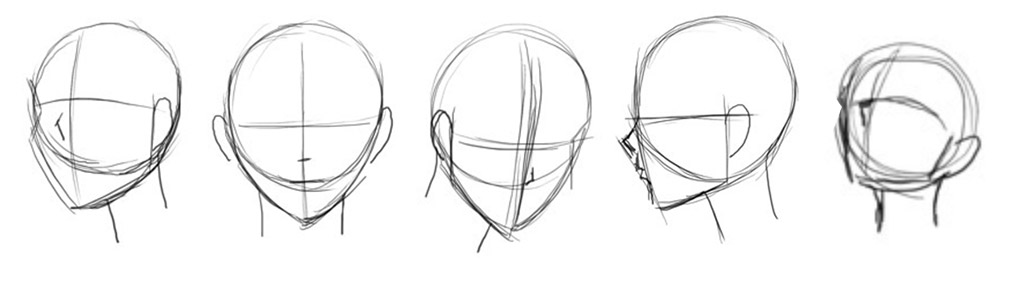
I draw the seed by starting with a circumvolve (or spherical ball, every bit I imagine it in my mind) and then hanging a pointed jawline off that circle a various angles. And so past drawing a "cross" dividing the center of the confront and where the optics will be, you can use this seed shape to depict that head from any angle. This is the shape I apply for Kate's caput in Paradigm Shift. Using this equally my starting indicate, I rough the entire head, then add in more particular before completing the final cartoon. I use this procedure for all my comics and illustration, working from rough forms through final image. This is how I use the seed shape to draw Kate from the front end, side and 3/four view:
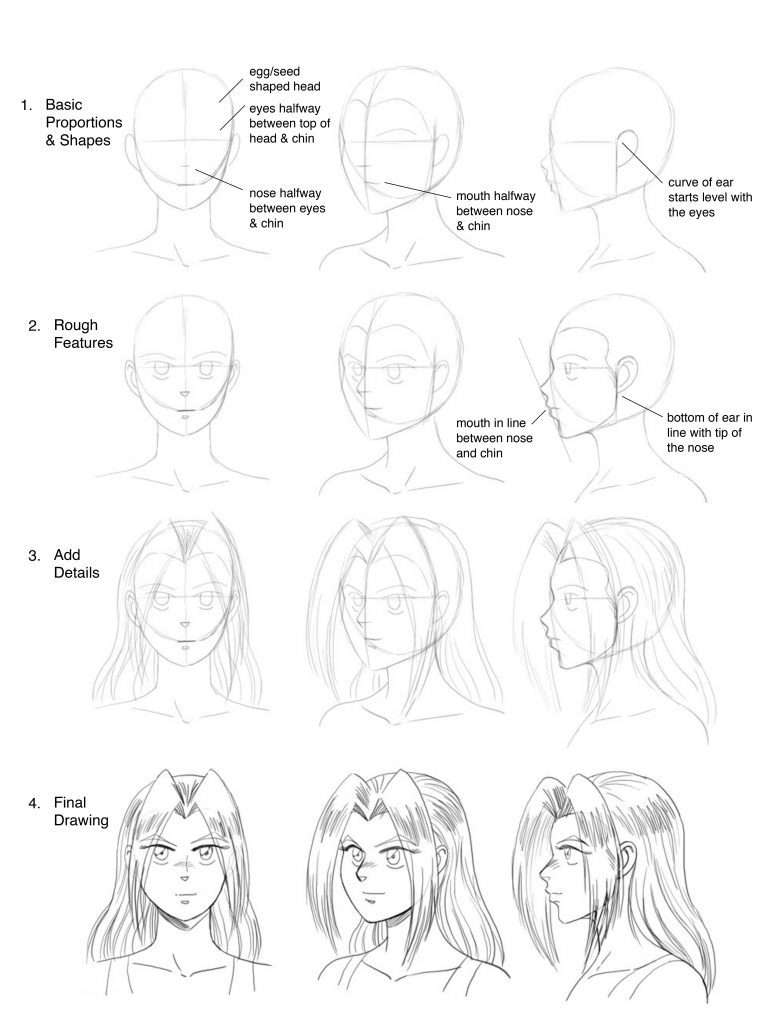
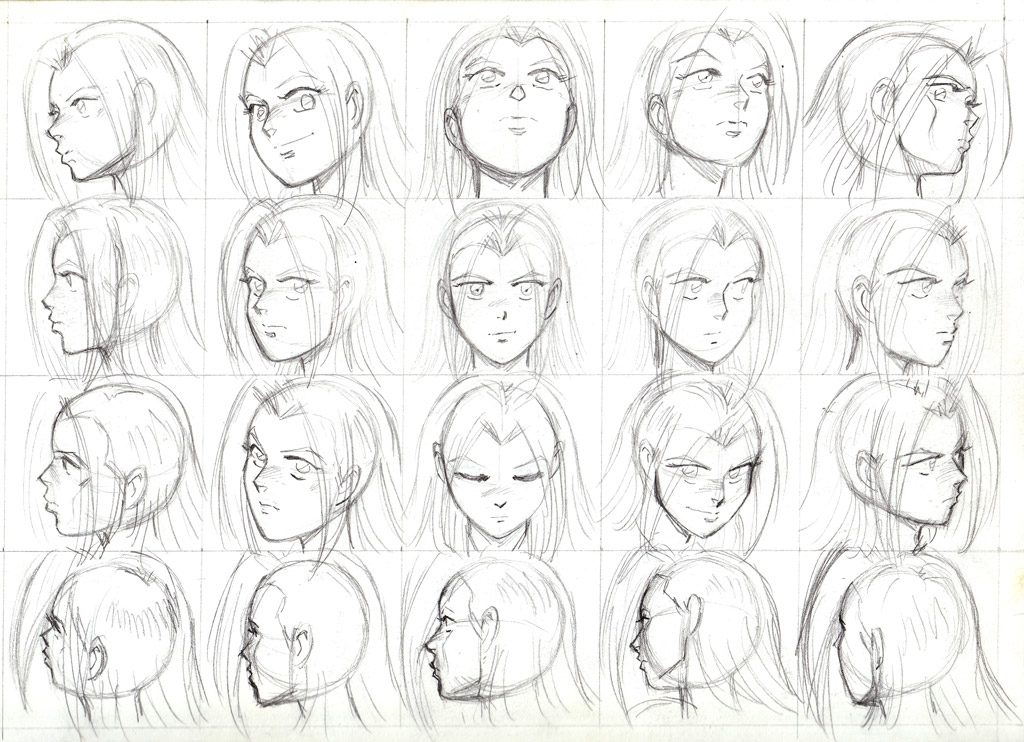
Take notation of how the proportions of the face translate beyond between the differing angles. The line that runs through the eyes is roughly halfway between the top of the caput and the chin. The tip of the nose sits about halfway between the eye line and the mentum. The mouth sits about halfway between the olfactory organ and the chin. From the side, if y'all describe a line from the tip of the nose to the chin, the lips will roughy fall in line inside in that location. The ears sit on a line that is halfway between the front of the head and the back and their curve starts in line with eyes. If yous imagine the heart line of the face curving to the left or right and the eye line curving up or down, you lot tin first to run across the head plow in your mind'southward eye and use this to describe the head and face from any angle like then:
The second basic head shape I use is based more closely on a more classical human caput shape used in American superhero comics:
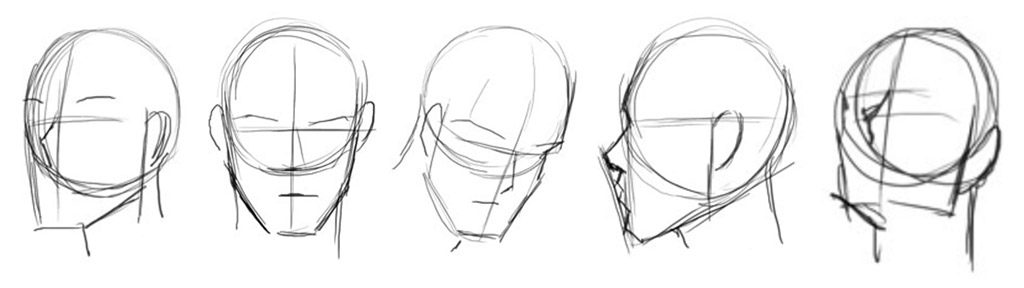
This is the shape I use for Mike's head in Paradigm Shift. I start the head with more of an egg shape. Then, I decide which direction the head is facing by drawing a "cross", simply like in the seed instance above. I hang the jaw down from the egg shape Dissimilar the anime "seed", the jaw line changes more radically betwixt a directly on view and the profile. Information technology'south more a wedge shape and volition accept more than practise to draw from every bending. Y'all tin can imagine information technology being a bit like a cube, only tapering downward to create the chin. Also the attic isn't completely round like a sphere or egg, but rather is flattened somewhat on the sides. I announce this with lines along the sides of the forehead that wrap around the top of the head
Here's how I utilise this to depict Mike from the front, side and three/4 view:
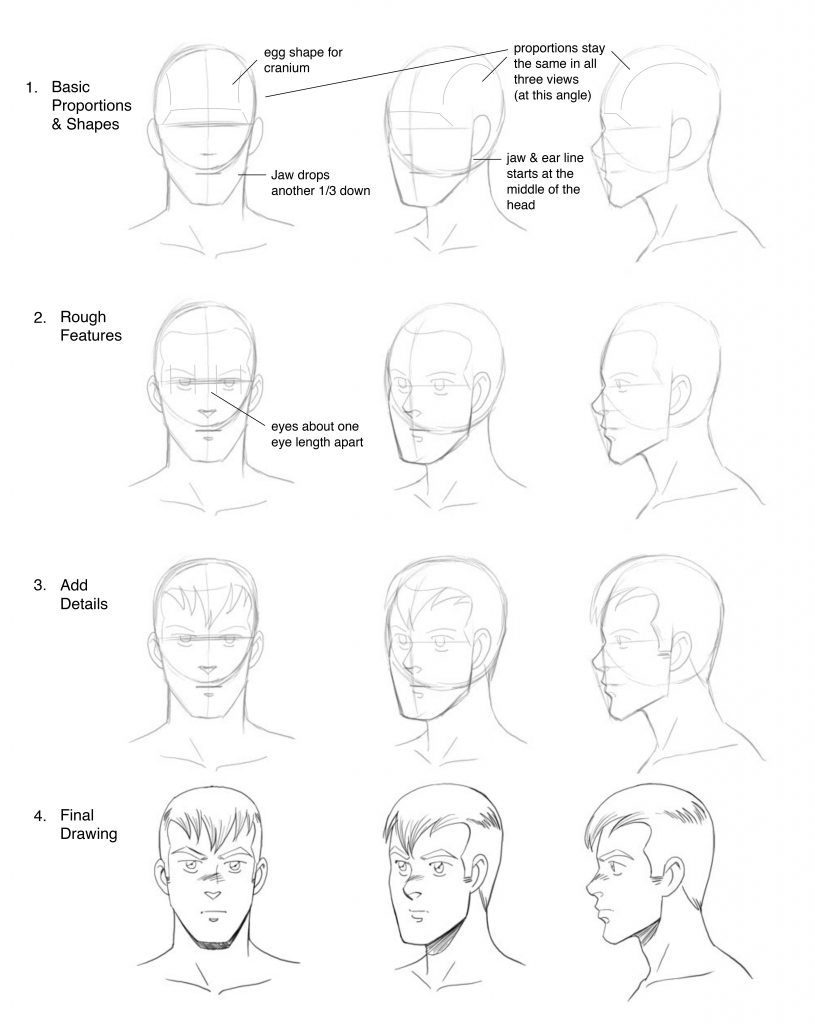
Like in the seed example, at that place are certain proportions to pay attention to, though they differ somewhat. In this style of head, the eyes lay well-nigh halfway down the egg shape. Then the jaw extends down a distance equal to about half the egg shape—thus dividing the face into thirds: acme of the head to eyes, eyes to bottom of egg shape, lesser of egg shape to mentum. The eyes are smaller on the face than in the previous example and at that place should exist roughly one eye distance between them.
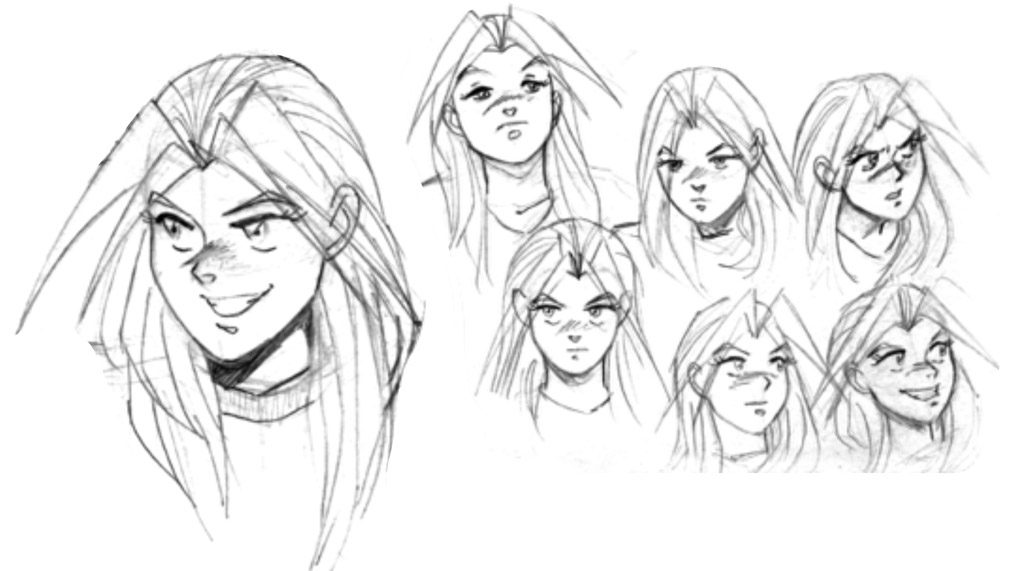
To work on details similar pilus and drawing heads from many different angles I recommend practicing cartoon from life, copying photos and doing the occasional primary study of an artist who you profoundly adore. The more yous do, the more you will expand your visual vocabulary as an creative person and y'all can combine, mix and friction match and create brand new features that are purely your own. The same goes for expressions. Play around in your sketchbook and discover the faces you feel express your graphic symbol'due south emotions the most vividly.
Drawing the Figure
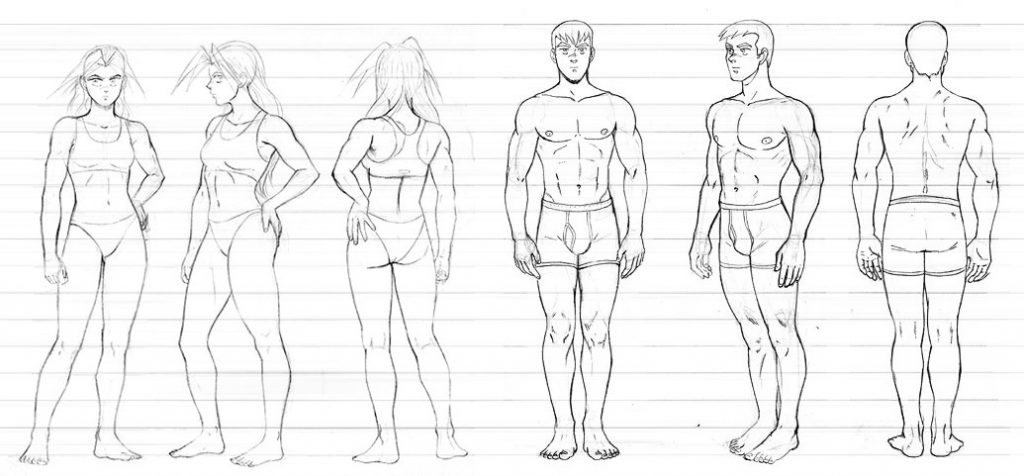
The first pace in drawing full-body human characters is to nail down basic proportions. Of grade, cartoon characters tin can be drawn with many different proportions, so I am going to focus on a relatively realistic homo proportions first. This method tin be modified to stretch characters to be taller or shorter as needed later. In a higher place we have Kate and Mike every bit examples of "platonic" man female and male proportions. Oft in effigy drawing, proportions are measured in "heads" because it is an easy mode to check if the features are in the right place in a drawing, especially if the effigy is drawn relatively direct on. Notice the lines going through the image to a higher place—they mensurate the number of "heads" used for each grapheme.
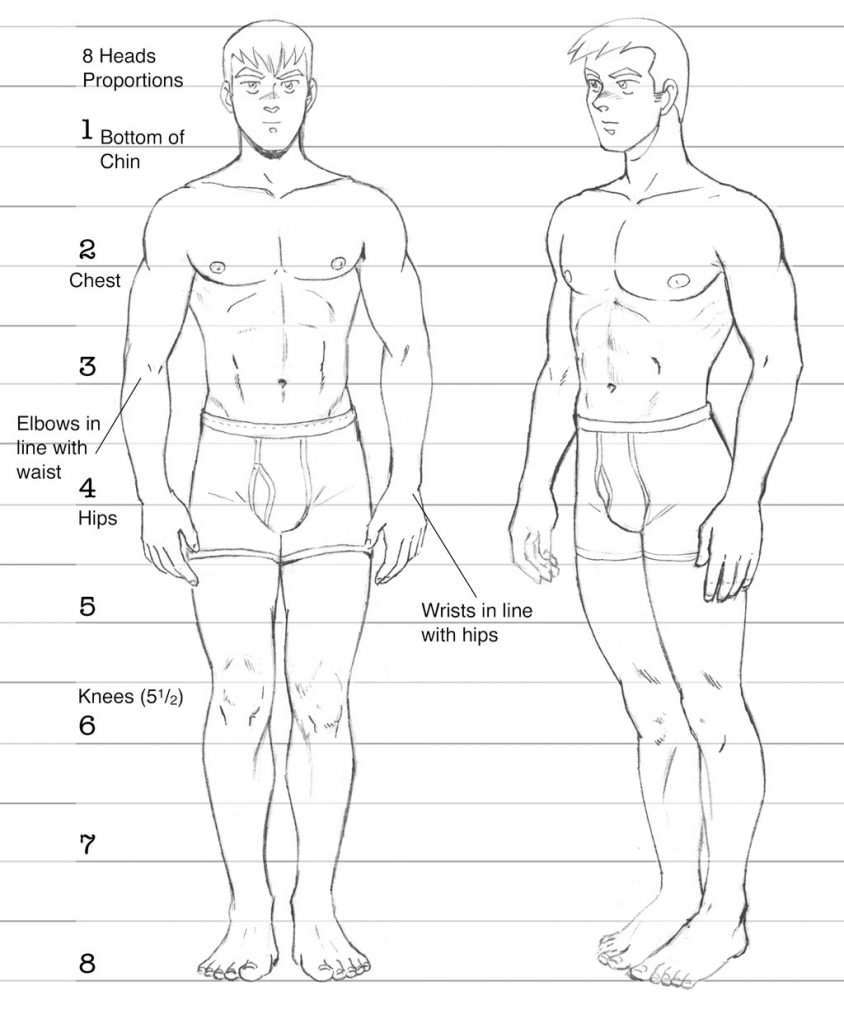
Mike uses classic western "heroic" proportions, measuring viii heads. They break downwardly equally follows:
-
- Head
- Chin to breast
- Chest to umbilicus
- Navel to bottom of the hips (crotch)
- Bottom of hips to mid-thigh
- Mid-thigh to knees
- Knees to mid-shin
- Mid-shin to bottom of the feet.
As well notation the proportions of the arm. The elbows are just above waist height and sit roughly in line with the lesser of the rib cage. The wrist fall approximately in line with lesser of the hips. For men, the ribcage and hips are roughly the same width and the shoulders are wider than the hips.
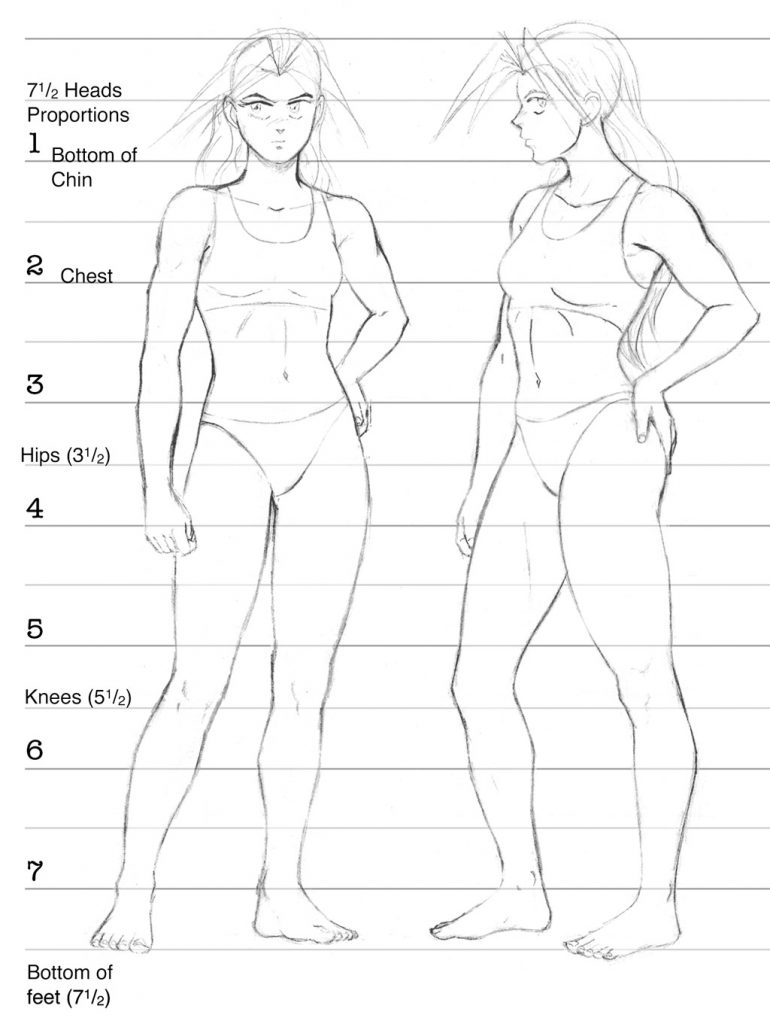
Kate is slightly shorter at 7 1/2 heads, which is closer to "realistic" human being proportions. The half head is lost around the hips, making her torso slightly shorter than Mike'south, while her legs are nigh the same length equally his. The "heads" break down as follows with her:
-
- Caput
- Chin to chest
- Breast to tiptop of the hips.
- Hips to widest signal of the thighs (bottom of the hips are nearly iii/4 of the manner)
- Widest point of the thighs to in a higher place the knees
- Above the knee to widest point of the calves
- Widest betoken of the calves to elevation of the ankles
- Feet (1/2 head)
Basically, Kate just has a smaller upper body than her analogue. Non only is information technology about a half head shorter, her ribcage is also narrower than her hips and that the midpoint of the shoulders sit roughly in line with the hips likewise. Her joints are also narrower and her limbs thinner.
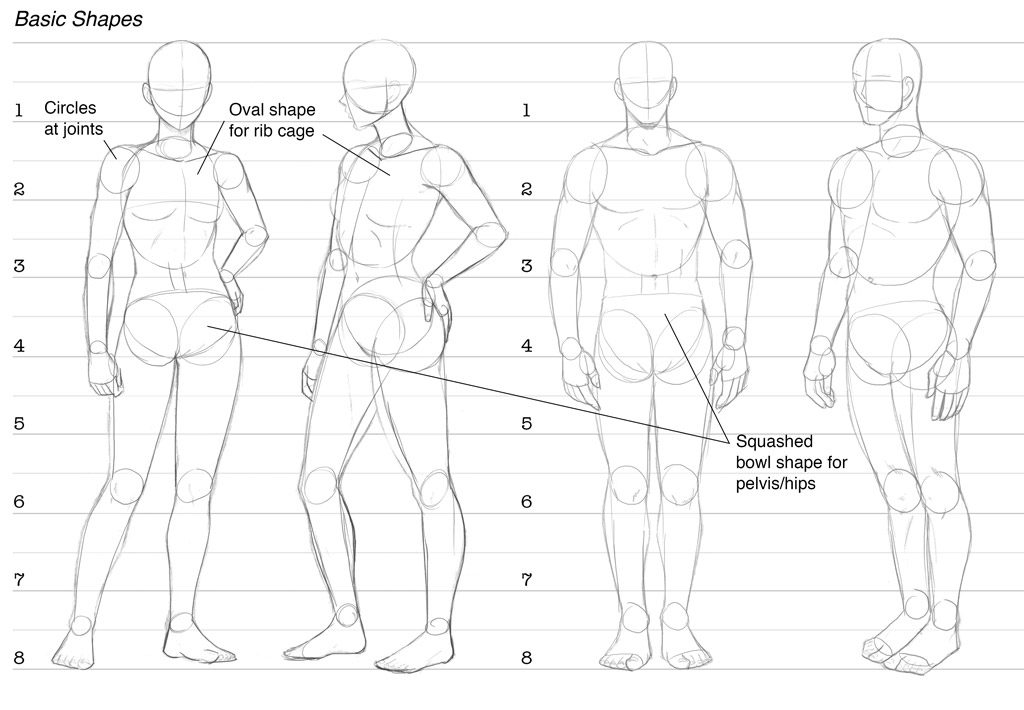
If we strip abroad the details and look at the underlying shapes, nosotros can encounter how each figure is constructed more hands. I use circles (which I remember of as "balls") in place of the joints and draw the forms of the limbs betwixt those. I use an egg shape for the ribcage and sort of a flattened "bowl" shape for the pelvis. I accept developed simplified forms for each of the major body shapes: upper arms, lower artillery, thighs, calves & shins, hand and anxiety. (More on hands and feet in a moment). I too imagine the shoulder being attached to the collarbone (which it is in reality, every bit well at the scapula on the back) then it is gratuitous to slide around up and downwardly, back and along on the ribcage when I am posing the figure. Take note of the hip shapes between the two figures.The male'southward pelvis is taller while the female'south is shorter and a niggling wider. This has been a helpful observation for me in my figure drawing.
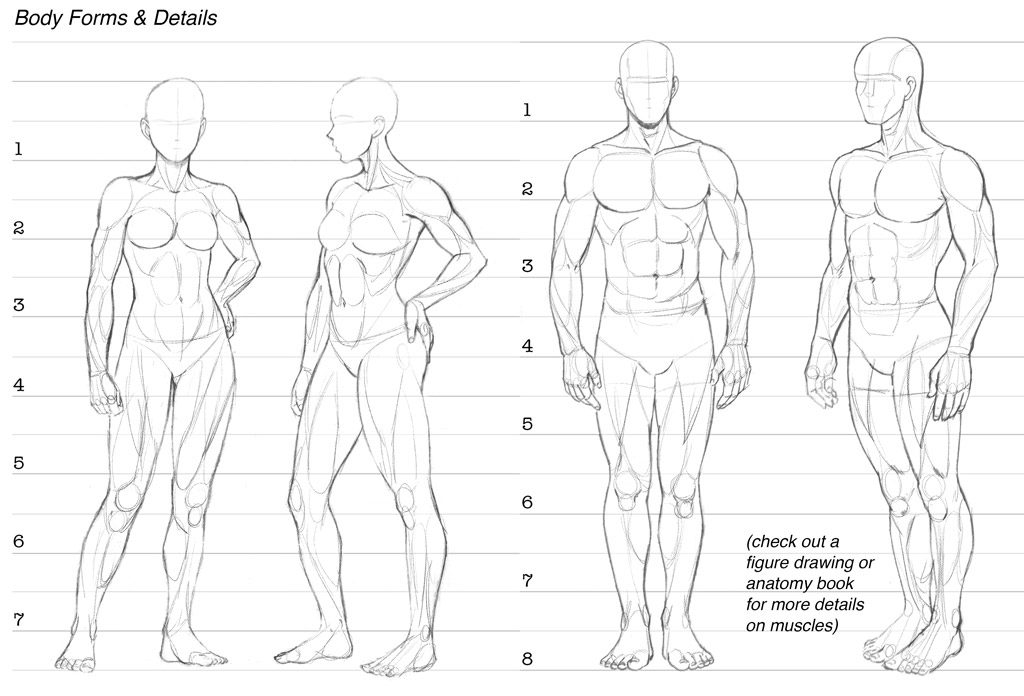
While I won't go into particular on muscular anatomy (there are entire books on that topic), hither is a quick cheat sheet on the basic shapes I'k thinking of when I'one thousand drawing the figure. These shapes are informed by endless hours of drawing characters and human forms from observation and copying drawings out of anatomy books. I highly recommend spending some time on this yourself.
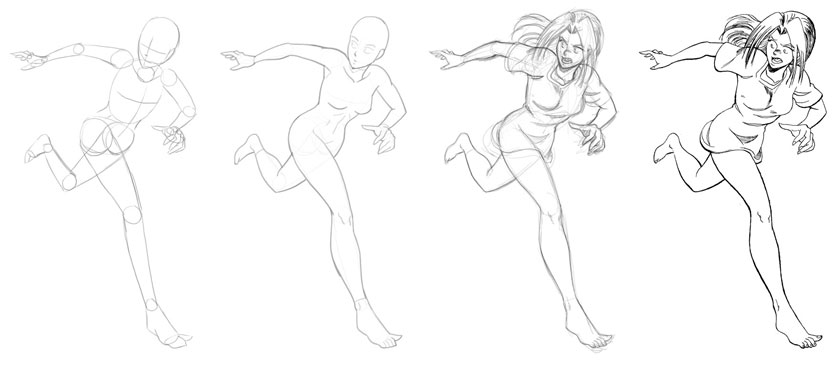
Strike a Pose
Okay, at present that nosotros take the basic shapes and proportions downward, we need to be able to draw our characters in more than shut-ups and continuing around doing cypher. We demand to put them into motion and so they have on some life. To do that, we need to start with a fluid fix of lines, or "gestures". For the to a higher place drawing, I started with a crude drawing like this:
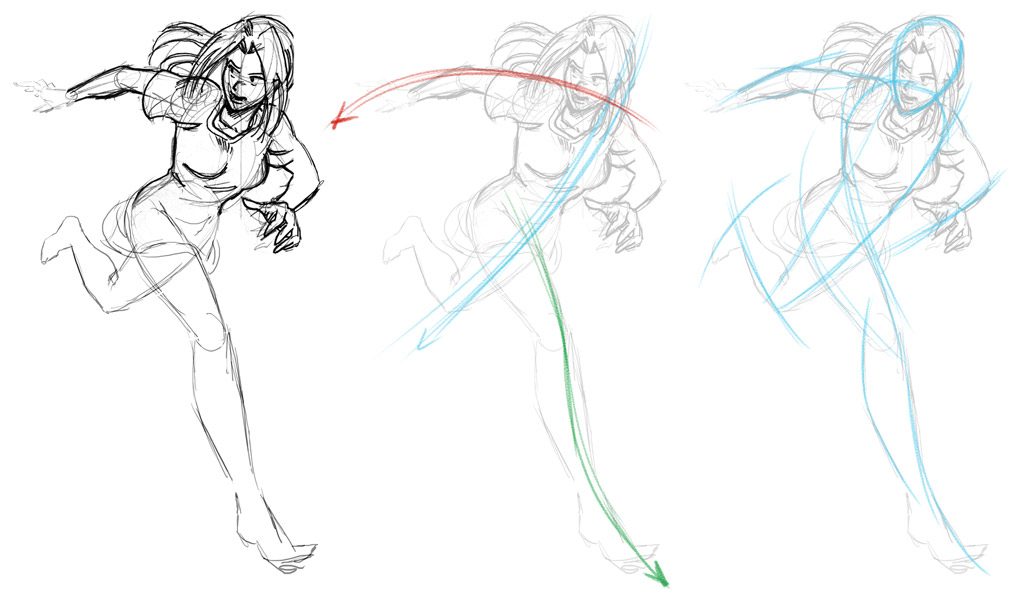 However, in the second image, these were the lines I was using to construct the effigy. These are the "gesture" lines—named after 30-second "gestural drawings" which are frequently done at the beginning of a figure drawing class. The starting time line in blue goes from Kate's head downwards to her knee. The 2nd in blood-red arcs along her arms and shoulders, and the final, in green follows her outstretched leg. Notice how these curves help tie the the forms of the figure together. I utilise lines similar this to build up a pose so information technology has some underlying life. In the third image, here are some more than "catamenia" lines that pass through the pose. These are the sorts of curves I expect for when edifice up a figure. No directly lines if I can manage it.
Here are the rough forms I'chiliad using to think through this rough effigy. I volition ofttimes draw a quick version like this as a thumbnail, and so depict these forms over the top of that rough to clean up the anatomy.
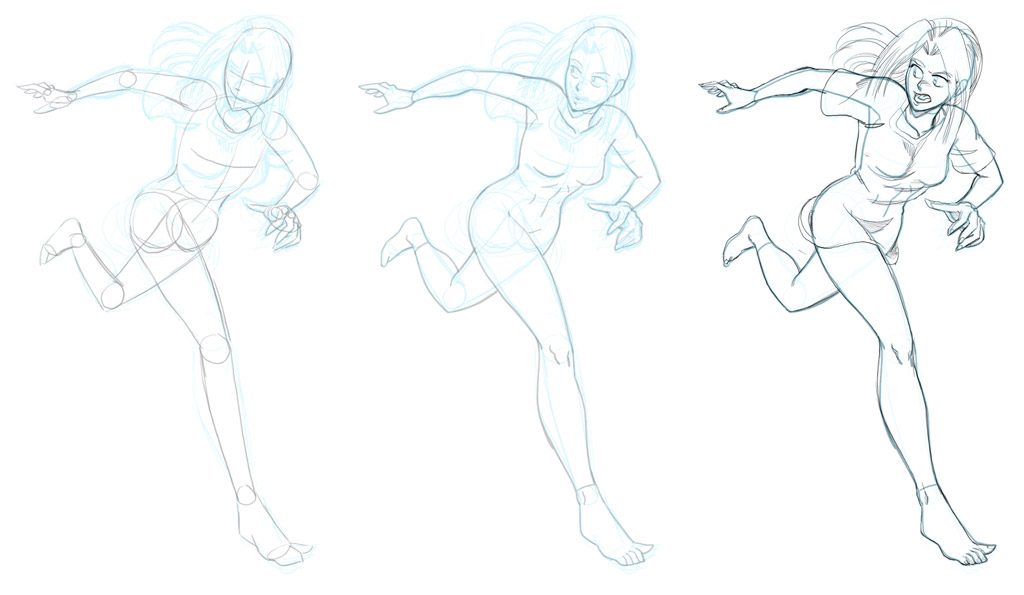
One time the anatomy and proportions are solid, I pencil over the rough and ink the final. I always apply this process for creating my finished works. By layering over more than and more finished versions, the concluding benefits from having several chances to correct mistakes along the style.
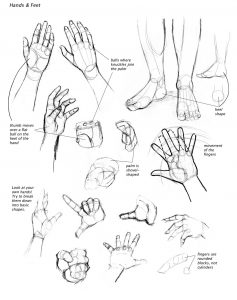
I could do an entire post lone on cartoon easily and anxiety (again, entire books take been written), only the brusque version is that the way to tackle these complex forms is the aforementioned equally to a higher place: suspension them down into simpler shapes. I outset with sort of a "shovel" shape for the palm, then depict a circumvolve to one side or the other on the wrist end to denote the ball of the thumb. Then I describe a smaller rounded shape on the other side to create the heel of the paw. Each of the four knuckles I draw every bit circles beyond the summit of the shovel shape, and and then a fifth at the end of the ball of the thumb. From there, I draw the fingers an thumb every bit either a mass (if they are clumped together) or every bit curved lines roughly indicating each finger. So I flesh out the private joints of the each finger as separate shapes, keeping in mind that they are non cylindrical, but more than similar like rounded blocks.
Drawing swell hands takes a lot of practice, and the best fashion to get expert at them is ascertainment. Only like the residuum of the figure, do cartoon from life and practiced reference photos to not only do the forms of the paw, but also to see how elegant hand poses come together. You volition outset to see patterns in how the fingers move together as a loose group, not separately (which is why magicians are illustrated using weird hand poses—they don't wait natural). I still practice by using my ain hands as reference to help create good hand poses.
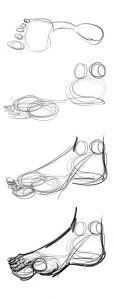 Feet are not as complicated as easily, merely they still pose a claiming to people new to drawing the figure. One time once more, breaking downward the forms into simpler shapes tin be helpful.It'southward helpful to me to remember of a footprint as a starting point—the heel is separated from the ball of the foot and toes past the arch of the foot. Nosotros can flesh out those shapes past using balls over again: 1 larger one for the heel, and two smaller ones for the ball of foot, leaving room for the curvation on the within curve of the foot. To a higher place the heel is the ankle, which has ii small bones on each side that connect down to the top of the brawl of the foot to create the main wedge of the foot. For the toes, I think of the classic "ninja sock" with the large toe acting independently of the rest of the toes, which more often than not clump together every bit a group. When the character is wearing shoes, so all the toes working together every bit a group. If y'all're drawing a bare foot, then go along in mind the smaller toes have a "stair-step" shape to them.
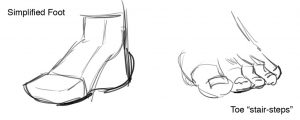
Once y'all have the basic foot shape down, y'all can work on putting it in shoes or drawing it bare. It volition have some practice to primary these shapes, so once more, using references and alive observation will help you lot refine your drawings.
Lastly, I desire to emphasize how helpful drawing in a sketchbook can be to aid you refine your graphic symbol drawing. For a couple of years, I drew graphic symbol studies of Kate & Mike by using photos from magazines equally a reference. I borrowed the poses and outfits, but transformed the models into my characters. The drawings below are from those sketchbooks.
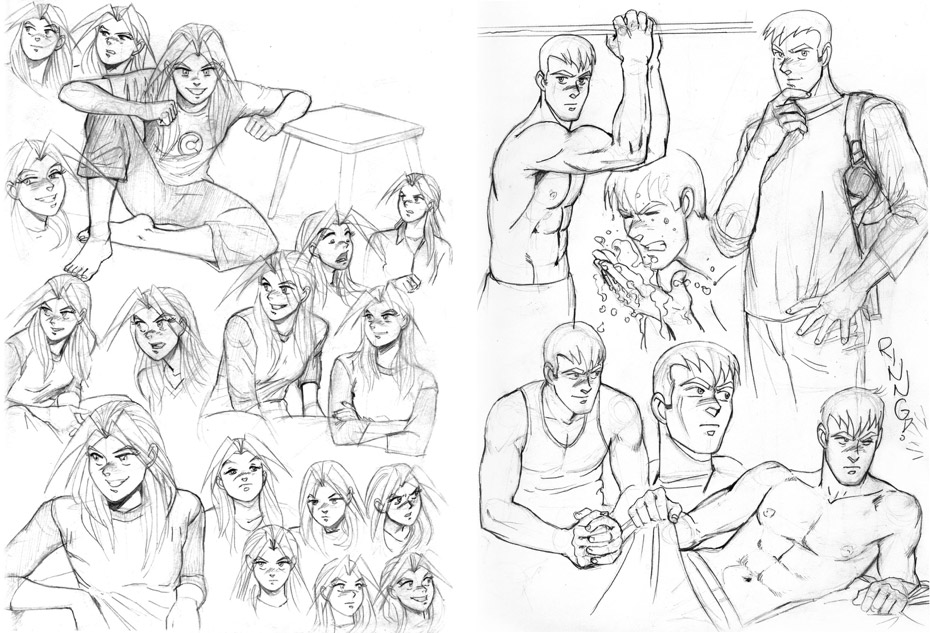
I hope this will assistance you create your ain character designs and give some tools to refine them.
Next time, we'll dive into the story.
If you lot're new to the serial, welcome! If y'all'd like prompt updates most the next installment of the serial, exclusive cheat sheets, and other behind-the-scenes material with each installment of the serial, please sign up for my mailing list:
barronseetumbrave1962.blogspot.com
Source: https://www.dirktiede.com/2017/11/03/how-to-draw-comics-character-design-drawing-the-figure/
0 Response to "Realistic Full Body Human Figure Drawing"
Post a Comment